
Headline after headline—AI this and AI that. Hell, I woke up to my Twitter feed to see the founder of Twitter slashing headcount. Shocked? No. There’s blood in the water, and like Chief Brody sitting on the back of the Orca chumming the sharks, the hacks we call journalists keep throwing more blood in the water.

Headline After Headline – AI This and AI That.
I look at things a bit differently and am super excited. I’m excited because I am imagining what our world could be. And there is the challenge.
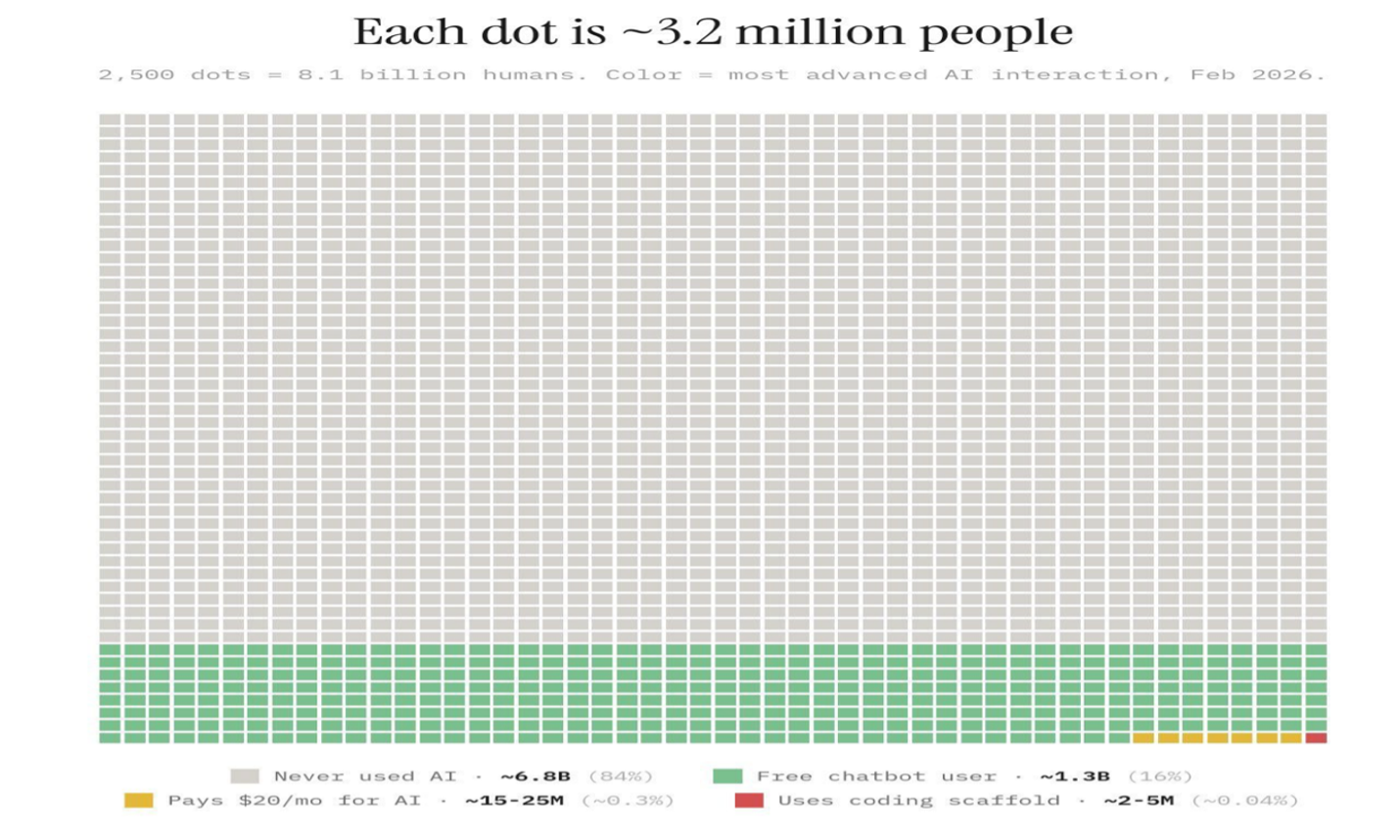
AI Usage Across the Global Population — Adoption remains narrow at the highest-impact tiers
This image lays out AI usage across the global population. The vast majority of people do not even use the tools. About 1.3 billion are using free versions—and by the way, the free stuff is not really all that impressive, and if you think it is, well… check yourself.
There are about 15 to 25 million using some paid version of AI. And then at the far end: only 2 to 5 million people are using coded scaffolding formats of AI to actually improve their business.
There is not a broker I know who is not using AI for marketing—cool pics, videos. Cute, right. And I am sure there is some modicum of benefit. The reality is, though, unless you rethink the entire architecture of the business, you will not get the true benefit. And that, my friend, requires investment into real infrastructure and process flows.
Most brokerage operations are still organized around a familiar unit of work: the engagement. A business owner signs a representation agreement, the broker builds a CIM, markets the listing, and manages a sequential process—NDA, financials, LOI, due diligence, close. This model made sense when information was slow and coordination required human gatekeeping at every stage.
AI doesn’t fundamentally change that model if you just use it to draft faster or screen buyers more quickly. The brokers capturing disproportionate value today are rethinking the unit of work itself—breaking the deal process into smaller, independently manageable components that can run in parallel, generate feedback early, and adapt in real time.
Think of it this way: the traditional brokerage runs on sequential handoffs. The AI-powered brokerage runs on continuous coordination.
Consider how buyer matching currently works at most firms. A new listing goes live, the broker reaches out to a list of known buyers, waits for responses, and qualifies from there. It’s a process organized around the listing as a fixed object—something you prepare, present, and defend.
A restructured approach treats deal components as live, dynamic elements. Instead of a static CIM, imagine continuously updated deal profiles where financial metrics, seller context, and market comps are refreshed as new data comes in. Instead of one-time outreach to a buyer list, AI monitors buyer behavior—what they’re searching, what questions they’re asking, what deals they’ve passed on and why—and surfaces opportunities in real time.
The unit of work shifts from “the listing” to “the signal.” Every buyer interaction, every passed deal, every unsolicited inquiry becomes a data point that informs sourcing, pricing, and positioning on the next deal. This is not theoretical—it’s the same structural shift that separated Shein from traditional fashion retailers, who kept organizing around seasonal collections while Shein reorganized around continuous market signals.
Two Dimensions That Move Together
When brokerages try to modernize, they typically change one thing at a time. They adopt a new CRM but keep the same deal stages. They automate outreach but maintain the same qualification process. They use AI to draft documents but still route every decision through the same senior broker.
The firms creating durable competitive advantage are moving along two dimensions simultaneously:
- The unit of work—reducing the fundamental object from “the engagement” to the smaller components that make it up: the buyer signal, the valuation input, the diligence question, the market data point.
- The coordination mechanism—moving from sequential, approval-gated processes to continuous, AI-synchronized ones where teams share a live view of the deal rather than passing files back and forth.
When both shift together, the brokerage doesn’t just work faster—it learns faster. Every deal generates structured feedback that shapes how the next one is priced, positioned, and closed.
What This Looks Like in Practice
Here’s a concrete example. A traditional sell-side process might look like this: the broker gathers financials, builds a CIM over two to three weeks, launches marketing, runs NDAs and introductory calls over several weeks, then begins a qualification funnel. Information flows forward, rarely backward.
A restructured process treats the same work differently. The moment a seller engages, an AI-assisted data room begins structuring financial information and flagging likely buyer objections based on deal patterns. Buyer outreach runs in parallel with CIM development—not after it—using AI-generated teasers that adjust based on buyer profile. Feedback from early buyer conversations is captured and fed back into the positioning, so by the time the full CIM is circulating, it’s already been stress-tested against the market.
The result isn’t just a faster timeline. It’s a fundamentally better process—one that surfaces problems earlier, allocates broker attention to higher-value decisions, and builds institutional knowledge that compounds over time.
The Resistance You’ll Face—and What It Really Means
Every experienced broker reading this probably has a version of the same objection: “Deals are relationship businesses. You can’t systematize trust.” That’s true. But it misidentifies where the bottleneck is.
The relationships in a deal—the trust between buyer and seller, the broker’s credibility with both sides, the feel for whether a deal will actually close—those don’t get systematized. What does get systematized is everything that isn’t that: information gathering, document preparation, buyer screening, diligence coordination, communication sequencing.
When AI handles those layers, brokers get more time for the parts of the job that actually require them. The broker who spends three weeks building a CIM manually has less time to build relationships than the broker whose AI-assisted process surfaces the right buyers in the first week.
When firms resist this shift, it’s rarely because the logic is wrong. It’s because changing the unit of work redistributes influence inside the organization. Senior brokers who’ve built their authority around managing the sequential process—controlling when information moves, who sees what, when decisions get made—stand to lose that control when coordination becomes continuous and transparent. Leaders should recognize this resistance for what it is: not cultural inertia, but structural self-preservation.
The Question Every Brokerage Principal Should Ask
The right question isn’t “Are we using AI?” Most firms are. The right question is: “Does the way we organize deals still make sense given what AI now makes possible?”
If your deal process still moves through the same sequential stages it did five years ago—just with some faster document drafting—you’re not gaining structural advantage. You’re renting efficiency while your competitors build architecture.
The bottlenecks that define your firm’s ceiling aren’t the tools you’re using. They’re the units of work you’ve accepted as fixed: the CIM as the marketing gateway, the LOI as the coordination trigger, the closing as the feedback moment. Each of those can be broken down, distributed, and accelerated—if you’re willing to rethink how the work itself is organized.