
I am honored to lead the Business Brokers of Florida this year. I am fortunate to have a large group of dedicated volunteer leaders, a strong assembly of members and affiliates, and a great management team to help our Association be the best in our profession.

Chair’s Letter
I would like everyone to mark their calendars for our upcoming BBF Conference, August 23-25 at the Caribe Royale in Orlando Florida. Some fantastic education sessions are in the plans and a fantastic opportunity to network with other Business Brokers. I find at these events, I sometimes learn as much from other Brokers while networking as in our workshops. Both are reasons to make sure you are there. Sign up will be coming soon, sign up early to participate in the maximum discount from registration.
Lots of improvements are being made to our public facing website with search capabilities for our members and affiliates. We are working to give you more exposure to the public. There is contact information on each office as well as each member. A link to your website is included which will help the SEO on your website.
We will be ordering awards soon to recognize those members that achieved different levels during 2023. Please make sure all your SOLDs are up to date in our BLS system.
There is lots going on in BBF and many committees that need volunteers from our membership to help move BBF to the next level. Please contact me if you are willing to serve. I would like to thank all those members that do serve, we all appreciate all you do for BBF.

Paul McNally
Chairman, Business Brokers of Florida®
Presenting the right CIM, CBR or Brochure for your listing
Our duty as Brokers is to showcase our business listings with as much detail and accuracy as possible so as to wow the Buyer. One way to do that is through the preparation of a Confidential Business Review (CBR) or a Confidential Information Memorandum (CIM). These two terms are often intertwined and used in the same manner. The difference between these two documents is that the CIM is usually prepared by Investment Bankers and M&A Advisors for Mid-Market and Medium Size Business offerings. CBRs and CIMs reflect the heart and soul of the business. They are time consuming and can only be put together once all the relevant information on the particular business has been obtained by the broker, including research on the industry and the market where it operates.
What’s the purpose of a Confidential Information Memorandum?
A Confidential Information Memorandum (CIM) is a professionally prepared lengthy summary of your business that is presented to prescreened buyers who are interested in purchasing your business. The CIM addresses the buyer’s questions quickly and efficiently, saving countless hours. It includes information regarding company history, products, services, licensing, and competition. It also includes a financial summary, information about operations, lease terms, the value of assets and inventory, an employee summary, and terms of the sale. The purpose of the CIM is to help the buyer decide if they would like to take the next steps and learn more about the business. The CIM will not address every question the buyer may have about the business. Rather, it allows the buyer to take the next steps in the transaction.
What is included in the CBR (20-40 pages)?
Here are the major topics typically covered:
- Disclosures
- Assets
- Competition
- Customers
- Deal structure and financing
- Facilities & Equipment
- Financials
- History
- Improvement potential
- Intellectual property
- Inventory
- Operations
- Pricing
- Product or service
- Staff
What’s included in a CIM (50-150 pages)?
In addition to the above, it may include these additional topics:
- Company Overview and History
- Competitor Overview
- Contracts
- Customer Overview
- Geographic Market Overview
- Growth Opportunities
- Industry Overview and Key Metrics
- Legal and Environmental Items
- Management Bios
- Marketing and Sales Team Overview
- Organizational Structure
- Product Information and Specifications
- Production or Service Processes
- Supplier Overview
- Technological Capabilities
As you may have noticed this is an extensive and comprehensive portrait of the business that requires accurate and detailed research and analysis of all information gathered from Seller and online. These documents answer most questions Buyers will have. They are one of the most important marketing tools we have to showcase our listings. But you don’t always need to have such an extensive portrayal of a business if it’s not that sophisticated. Smaller valued businesses can also be showcased using a Confidential Summary Booklet (5-10 pages) or a 2-3 page flyer/brochure. Regardless of what type of Memorandum or Flyer you decide to use, make sure it’s colorful, insightful, with graphs, tables and valuable content, in other words “eye candy”. Sometimes less is more in order to trigger the Buyer’s interest and curiosity. Therefore, make it a habit to impress both Buyers and Sellers with your professionalism, expertise, value and effort you place in the marketing of your listings. CIMs can cost anywhere from $500 to $2500 to have it done professionally, if you do not possess the skill.
If you’d like to see samples of CIMS or CBRs feel free to email me at mhabib@theroyalcrowngroup.com so I can share some of them with you.

Mark Habib
The Royal Crown Group
Seven Reasons Why a Buyer May Expect Working Capital to be Included in the Sale Price of a Business
What is working capital? Working capital represents the short-term liquidity and financial health of a business. Positive working capital can indicate the business is well-managed and financially stable. Working capital is the money available to meet current, short-term obligations. It is calculated by subtracting short-term liabilities from short-term assets. Short liabilities include accounts payable, salaries, taxes, and other debts/accrued expenses. Short-term assets include cash, accounts receivable, and inventory that will be converted into cash within twelve months.
Oftentimes, sellers are taken by surprise when a buyer demands a specific amount of working capital to be included in the sale price of a business. In lower-middle-market valuations based off EBITDA multiples, working capital is included in the price. In main street business valuations based off SDE multiples, working capital is not included in the price. However, with a stumbling economy, more sophisticated lower-middle-market buyers are reaching down into main street businesses and applying their expectations to main street acquisitions. So, why would a buyer want to include working capital in the acquisition?
Here are seven reasons why a buyer may expect working capital to be included:
1. Ensures Business Continuity
Working capital is essential for the day-to-day operations of a business. By including working capital in the sale price, the buyer ensures the business will have sufficient funds to continue its operations smoothly after the acquisition.
2. Creates Seamless Transition
Working capital helps create a smooth transitional period during which the buyer takes over the operations. By including working capital in the sale price, the buyer has immediate access to funds to cover initial expenses, pay suppliers and employees, handle any unexpected costs, etc. during the transition.
3. Avoids Additional Investments
Working capital avoids the need for the buyer to inject additional capital just to maintain the current operations of the business. By including working capital in the sale price, the buyer can avoid having to make an additional investment immediately after the acquisition.
4. Mitigates Risk
Working capital can indicate the business is well-managed and financially stable. By including working capital in the sale price, the buyer reduces the risk of acquiring a business that may be struggling to meet its short-term obligations.
5. Simplifies Negotiations
Working capital simplifies the negotiation process. By including working capital in the sale price, instead of negotiating a separate amount for working capital, both parties agree on a total purchase price that includes the estimated working capital needed to operate the business.
6. Avoids Disputes
Working capital can be a contentious issue in negotiations if not explicitly addressed. By including working capital in the sale price, both parties avoid potential disputes or disagreements over the specific amount of working capital at the time of the sale.
7. Simplifies Handing of A/R and A/P
Working capital simplifies the handling of accounts receivable (A/R) and accounts payable(A/P) after the sale. By including working capital in the sale price, A/R and A/P do not need to be allocated between the buyer and seller. The buyer can simply receive revenue and pay bills as if the sale never occurred.
It is important to note the inclusion of working capital in the sale price should be clearly defined in the purchase agreement. Both parties should agree on the methodology for calculating the working capital amount, any adjustments, and the target working capital amount at the time of the sale. Proper due diligence is crucial to ensure the working capital included in the sale price accurately reflects the needs of the business and is fair to both parties.
Sources: Bank of America and Chat GPT

Eric J. Gall
Edison Business Advisors
Eric is the registered broker and founder of Edison Business Advisors. Over the past 25 years, Eric has participated in many forms of business transactions closing in on $300M. He has earned 34 awards from BBF, IBBA, and M&A Source since 2010. Eric is the President of BBF Southwest Florida Region and serves on M&A Source Deal Market Committee and BBF State Board.
Buying a Business: What is the Real Value of a Business?
Using “multiples” to value a business may be a disservice to both the seller and buyer. “Multiples” may not represent the real value of the business.
Multiples are generally median or average values published in the BBF MLS or in Pratt Stats/Deal Stats. However, these are just convenient “midpoints” that do not represent any specific transaction. These multiples are based on historical information, a different market area, a different economic environment, a different seller’s perspective, etc. Unless the transaction being “valued” is truly an average transaction, then using these multiples is misleading.
These multiples are applied to recent historical financial performance of the business (transaction being contemplated).
What is the “real” value of a business? Standard concepts/definitions used credentialed valuation specialists to value a business are:
- The “Present value of future economic benefits to be derived by the owner of the business.”
- The price that would be agreed on between a willing buyer and a willing seller, with neither being required to act, and both having reasonable knowledge of all relevant facts.
Future economic benefits are important relevant facts in valuing a transaction and are based on:
- The Industry: Is it in a growth, mature or declining stage
- The Market Area: Is it growing, stable or declining with respect to population, household income, etc.
- The Business: Growing, stable or declining
- The Terminal Value: An estimated economic benefit to be realized at divestiture
- The Owner: Reasons for exit
A Real-Life Example:
This was a rapidly growing business in a mature industry but in a growing market. The following graphs show historical performance and statistically projected growth.
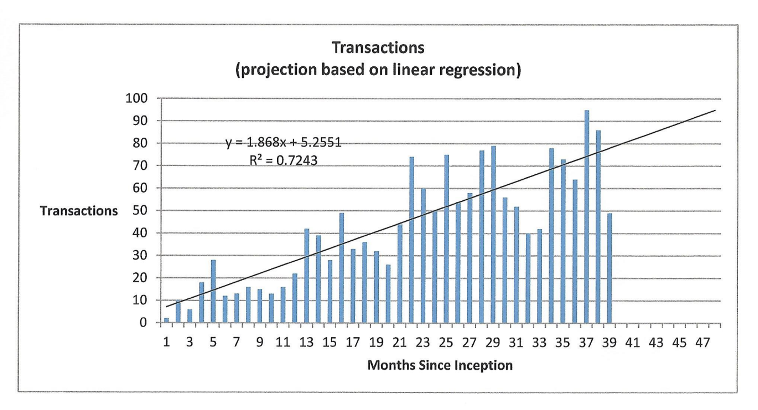
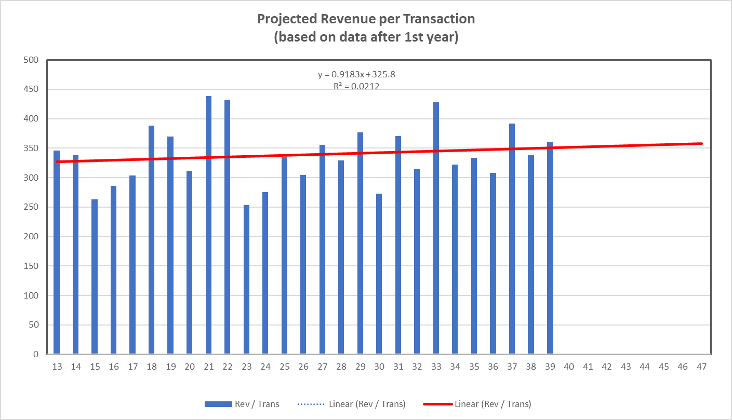
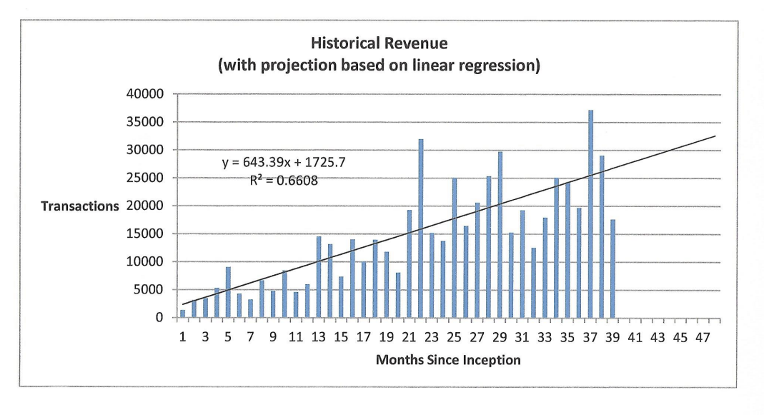
This business should have been “valued”, given knowledge of all the relevant facts, based on future economic benefits. Even though the industry was mature the market area was growing in both population and economic prosperity and the business was growing due to identification of a niche in the market, good management and “sweat equity”. This resulted in increasing transactions, stable to slightly increasing revenue per transaction and increasing gross revenue. Bottom-line was increasing also due to reduction in early year start-up costs. There were substantial future economic benefits in the business.
Nonetheless, the buyer wanted to focus on multiples of historical performance. Why?

Jim Bolinger
Truforte Business Group
Mr. Bolinger’s career has spanned 45 years working in finance, organizational strategy, business planning and as a small business owner. Positions have included:
- Senior Manager, Audit Services Division, International CPA firm
- Vice President and Chief Financial Officer, large community hospital
- Partner, national consulting firm focused on strategy as well as mergers & acquisitions
- Managing Partner & Co-founder, national consulting firm focused on strategy, business planning, mergers & acquisitions and business valuations
- Business Broker, Truforte Business Group
Education:
- MBA with Honors, University Notre Dame
- Bachelor of Science in Business, Indiana University.
Publications and Presentations:
- Selling a Business? Avoid These Mistakes, Southwest Florida Business Today (February 2021)
- Why Now is the Best Time to Buy/Sell a Business, Above Board Chamber webinar (November 12, 2020)
- Preparation Boosts Success When Selling a Business, Southwest Florida Business Today (August 2019)
- Buying or Selling a Business: Strategies and Tactics (SCORE, South Bend, IN and Fort Myers, FL)
- Medical Practice Valuations, Executive Checklist Series (an Arista publication)
- So You Want To Start A Business (SCORE, Fort Myers, FL)
- Understanding Financial Statements (SCORE Mentor Boot Camp, Southwest Florida)
- Leading Change/Managing Transitions: The Human Factor (Indiana Society of CPA’s)
- Sustainable Collaboration: Precedents to Success, Executive Checklist Series (an Arista publication)
Professionalism at its Core
I recently completed a comprehensive program of next-level professional education, achieving the Master Certified Business Intermediary designation. In this inaugural Masters cohort, I was fortunate to learn with some of the industry’s most professional and vastly experienced business intermediaries and M&A advisors worldwide; in addition to that, the professors that taught each course were the best of the best, names that anyone in our industry would recognize instantly. I share all of this to set the context for where I’m going in this article.
The last segment of this course was focused on ethics and professionalism. One could question the need for a discussion on this topic when there was an easily combined three hundred-plus years of experience and undoubtedly professionalism amongst my peers. What could be taught about ethics to this level of intermediaries and M&A advisors? When, in fact, we only explored a small portion of the subject that could have been worthy of further examination.
These discussions sparked thoughts that made me reflect on the years of my practice and the people I have encountered not only as a broker of record for my firm but also, probably more importantly, over these past three years as chairman of the Business Brokers of Florida. The subject goes beyond the people working directly in our industry as it expands into associates in affiliates, we work with daily to get our deals done.
During the four-hour discussion, we discussed several different topics of what ethics and professionalism mean to teach us as a group of individuals accountable to our principles to keep and maintain those standards. We all saw common ground on the theological proverb of “do unto others, as you would have them, do unto you“ as a guiding principle to what should be the foundation of everyone’s character. In a perfect world, this would be nice.
The challenge with this practice of thought is that one risks dealing with individuals with their own thoughts and opinions based upon their own life experiences, spheres of influence, and, hopefully, theological upbringing. Some folks may be guided by cultural effects shaping their approach to what many would consider right or wrong. So, what one person feels was a usual way of life may be utterly offensive to another.
In our discussion groups, we challenged each other and the associations we connected to formulate something that reaches beyond the word “ethics,” as we felt that this doesn’t truly encompass the vast avenues of guiding principles or “code,” as it were. Our discussion groups dissected over twenty-five industry-specific topics, from “balancing the relationships between our principals” to “incentives or detriments that could affect the outcome of our deals” and much more impactful subjects on what we encounter daily. We could all agree that even though we do our best in our firms and deals, not everyone we deal with will have that same mindset. When faced with situations that are questionable in a deal or others as it pertains to something dubious in character, it is up to each of us to take a couple of steps back, reassess the circumstances, and confront the matter with a moral high ground.
Those who don’t operate in the realm of steadfast moral character stand out as the thorn in any industry or society and are what causes people to distrust one another. I pray that we can develop into a society of brothers and sisters, all working toward a common goal of greatness for each other and ourselves. It all starts with us doing our best to inspire and encourage others through our examples of virtuous character. This is the foundation for us as individuals and in our professional standards of practice in our firms and associations.
Ultimately, this course strengthened my confidence by realizing that the folks I have worked closely with over the years meet and even exceed those standards. I couldn’t be more honored and humbled to witness and be a part of this transformation in our Business Brokers of Florida membership. We continue to set the standard… professionalism at its core.

Joe Shemansky CBI, M&AMI, CM&AP
Chairman
Business Brokers of Florida